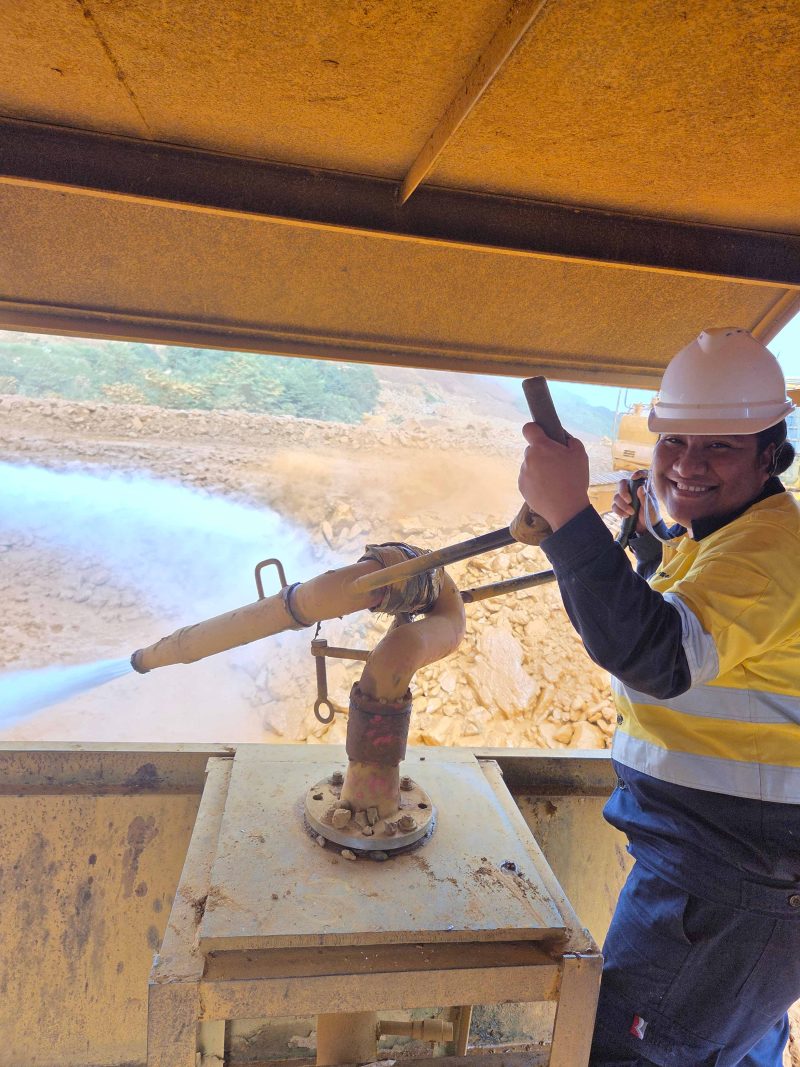
For Kovina Pariva, becoming a mining engineer was more than earning a university degree; it was the fulfillment of a childhood dream. Today, as a Graduate Mining Engineer under Ramu NiCo’s Graduate Development Scheme (GDS), she is transforming academic knowledge into practical experience while contributing to one of Papua New Guinea’s largest mining operations.
Originally from Kalo Village along the Rigo Coast of Central Province and a proud member of the Kunika Clan, Pariva has always been inspired by the opportunities the mining industry offers to young Papua New Guineans.
Her educational journey began at St. Peter Channel Primary School, where she completed Grades 1 to 8 between 2007 and 2014, before continuing to Marianville Secondary School from 2015 to 2018.
She later pursued a Bachelor of Mining Engineering at the PNG University of Technology, graduating in 2022.
Receiving the call to join the Ramu NiCo Graduate Development Scheme marked the beginning of an exciting new chapter.
“Receiving the call to join the Ramu NiCo Graduate Development Scheme filled me with excitement and gratitude,” Kovina recalls. “As a Graduate Mining Engineer, I saw this as a valuable opportunity to gain practical industry experience, develop my technical skills, and begin my professional career. It also gave me the chance to fulfil a childhood dream of working in the mining industry.”
Throughout her rotation within Ramu NiCo’s Mining Division, Kovina gained firsthand exposure to the full spectrum of open-pit mining operations. Working alongside experienced engineers, supervisors, and equipment operators, she developed a practical understanding of the processes that drive efficient mine production.
Her daily exposure included mining operations, safety management, production monitoring, heavy equipment operations, and operational coordination. She observed how excavators, articulated dump trucks (ADTs), and loaders work together to extract and transport ore safely and efficiently from the mine face to processing facilities.
One of her key learning experiences was understanding the complete KBK production process from excavating and loading to hauling and dumping ore.
Seeing the production cycle in action reinforced the importance of teamwork, planning, equipment reliability, and operational discipline.
Pariva also gained valuable geological knowledge by studying the different soil and ore horizons within the KBK deposit. She learned how each layer from the humid layer through limonite zones to saprolite and fresh dunite bedrock, plays an important role in determining ore quality and guiding mining operations. Understanding the characteristics and mineral composition of each horizon deepened her appreciation of how geology directly influences production decisions.
Safety remained at the centre of Pariva ‘s responsibilities throughout her rotation. She participated in daily pit inspections, identified workplace hazards, completed safety observations, and attended toolbox meetings that reinforced safe work practices across the operation. These experiences strengthened her understanding that production success must always go hand in hand with a strong safety culture.
On the production side, she tracked daily mining outputs, updated production databases, monitored fuel consumption, and prepared daily hazard reports. She also supported the administrative functions of the Mining Division by assisting with permit and licence renewals, collating operator timesheets, responding to operator enquiries, and helping with recruitment processes.
These responsibilities allowed her to appreciate the many behind-the-scenes activities required to keep a modern mining operation running efficiently.
During her rotation, Pariva monitored daily production performance, observing an average of 752 articulated dump truck (ADT) loads per day.
She noted that production generally remained stable, with night shifts often achieving higher outputs due to favourable operating conditions. Equipment availability emerged as one of the biggest contributors to production efficiency, while weather conditions also played a significant role in influencing daily performance.
Monitoring average monthly ore grades further enhanced her understanding of ore quality management, with average grades of 1.00 per cent nickel, 2.20 per cent magnesium, and 1.98 per cent aluminium providing important indicators for production planning and processing.
Although still in the early stages of her professional career, Pariva made valuable contributions during her Graduate Development Scheme rotation.
She assisted with daily production monitoring, improved the accuracy of production data recording, supported hazard identification and reporting, coordinated operational activities with supervisors, and helped maintain important administrative records and operator documentation.
Her willingness to learn, attention to detail, and commitment to supporting her team enabled her to contribute meaningfully while continuing to build confidence in her own technical abilities.
Like any mining operation, ,equipment downtime occasionally affected production schedules, while adverse weather caused operational delays.
Balancing production targets with strict safety requirements required careful planning and coordination, particularly when managing multiple operational activities simultaneously.
Rather than viewing these challenges as obstacles, Pariva embraced them as valuable learning opportunities that strengthened her understanding of mine operations and problem-solving under real-world conditions.
As she continues her journey with Ramu NiCo, Pariva remains committed to developing into a highly competent mining engineer.
Her future goals include expanding her technical mining knowledge, improving mine planning and production analysis skills, strengthening her leadership and communication abilities, enhancing her safety leadership, and contributing to continuous improvement initiatives within the company.
Reflecting on her experience, she credits the Graduate Development Scheme for providing a strong foundation for her professional career.
“The Graduate Development Scheme has provided me with valuable exposure to mining operations, safety management, production monitoring, equipment operations, and operational reporting,” Pariva said.
“I sincerely appreciate Ramu NiCo Management, the Mining Division, my supervisors, mentors, and colleagues for their guidance and support throughout my rotation,” she said.
Kovina Pariva’s journey demonstrates the value of investing in young Papua New Guinean professionals. Through structured learning, practical experience, and dedicated mentorship, the Graduate Development Scheme is helping shape the next generation of mining leaders—professionals equipped with the technical skills, safety mindset, and determination needed to contribute to the sustainable growth of Papua New Guinea’s mining industry.