For many young Papua New Guineans, receiving a phone call offering a career opportunity can be life-changing.
For Derrick Raimbas, that moment marked the beginning of an exciting journey into one of the country’s most important industries.
When Raimbas was selected to join the Ramu NiCo Management (MCC) Limited Graduate Development Scheme (GDS), his first reaction was not excitement alone, it was curiosity.
“When I first received the call for the Ramu NiCo Graduate Development Scheme, I felt curious and optimistic about the opportunity ahead,” Raimbas said.
“I was keen to learn more about the company, the role, and the experiences that would shape my development as an engineer and it represented an important first step toward building a rewarding career in the mining industry, he said”
That sense of curiosity has since evolved into confidence, technical competence and a deeper understanding of what it means to work safely and effectively in Papua New Guinea’s mining sector.
Originally from Zukin village in Bogia district, Madang Province, Derrick belongs to the Pukpuk Clan. His educational journey began in 2006 at Malala Primary School, where he completed Grades 1 to 8. He continued to Malala Catholic Secondary School for Grades 9 and 10 before completing Grades 11 and 12 at Sogeri National High School in Central Province.
Determined to pursue engineering, Raimbas was enrolled at the Papua New Guinea University of Technology (PNG Unitech) in Lae, where he completed his Bachelor of Engineering between 2018 and 2021, preparing himself for a career in mechanical engineering.
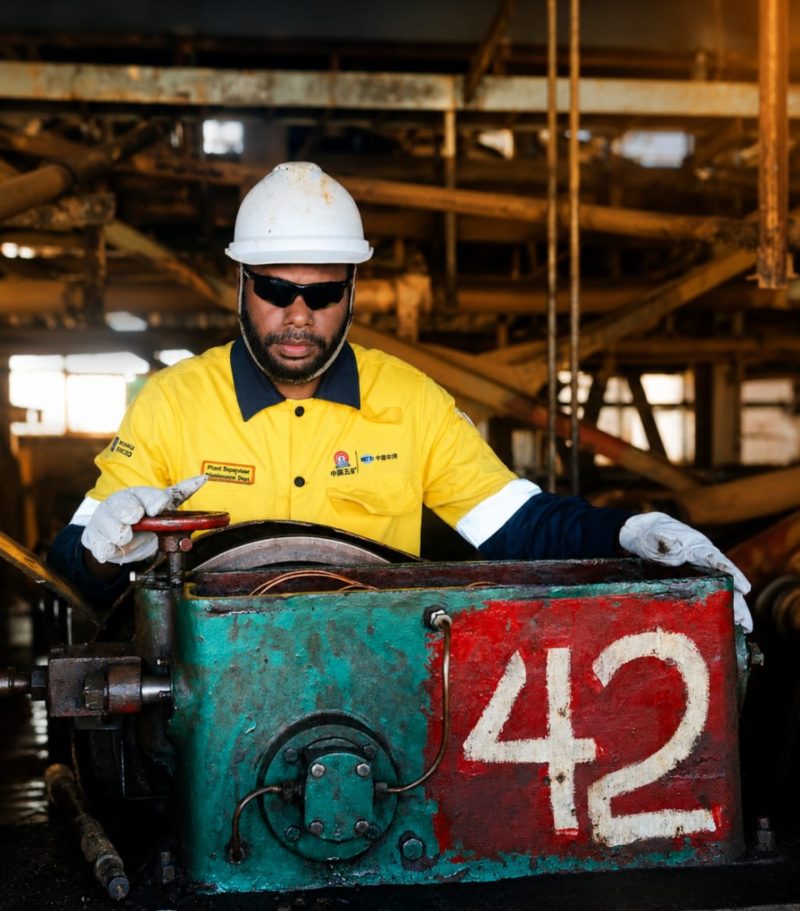
Today, he is applying those academic foundations in a real-world environment through the Graduate Development Scheme, serving as a Graduate Mechanical Engineer in the Beneficiation and Washing Plant Maintenance Department at the Kurumbukari Mine. His six-month placement, from November 2025 to May 2026, has exposed him to the operational heart of one of Papua New Guinea’s largest mining projects.
Working within the Fixed Plant Maintenance team, Derrick gained firsthand experience in understanding plant operations, equipment functions, maintenance planning and the practical application of engineering principles. From studying overall process flows to learning equipment specifications and maintenance repair techniques, the placement has strengthened his technical knowledge while developing his problem-solving skills.
One of the most valuable lessons throughout his placement has been the importance of workplace safety.
At Ramu NiCo, safety is embedded in every maintenance activity. Raimbas quickly learned that engineering excellence begins with protecting people.
The company’s proactive safety culture is reinforced through strong leadership, with team leaders ensuring that work is carried out safely while superintendents promote safety awareness during daily toolbox meetings and briefings.
Throughout his placement, Raimbas became proficient in essential safety systems including Job Safety Analysis (JSA), Permit to Work (PTW) procedures, Take-5 Good-To-Go assessments, Lockout-Tagout (LOTO) isolation practices, and the company’s Eight Golden Rules that guide safe behaviour across the operation.
These systems are more than procedures on paper—they are daily practices that safeguard workers and ensure maintenance activities are completed without incident.
Beyond safety, Raimbas was exposed to a wide range of equipment inspection techniques. He learned how experienced maintenance personnel use both visual and auditory inspections to identify potential equipment failures before they become major problems.
Visual inspections involve checking machinery for signs of wear, leaks, corrosion or structural damage, while auditory inspections require mechanics to identify unusual sounds—sometimes using a mechanic’s stethoscope—to detect faults developing inside equipment.
Among the technical case studies that stood out during his placement was diagnosing a fatigue fracture caused by continuous cyclic loading. Raimbas observed how the maintenance team analysed the failure before replacing the damaged axle bushing, reinforcing the importance of understanding equipment failure modes and selecting appropriate repair methods.
The placement also highlighted the realities of working within a large mining operation.
Raimbas sees some chanllenges such as language differences among the workforce, shortages of nationally-skilled maintenance personnel.
Rather than viewing these issues as obstacles, he believes they present opportunities for continuous improvement.
He recommends engaging industry specialists to help implement a comprehensive asset management and reliability framework that would strengthen maintenance planning, improve equipment reliability and support long-term operational efficiency.
Reflecting on his Graduate Development Scheme experience, Raimbas says the journey has provided much more than technical knowledge. It has developed his professional discipline, strengthened his appreciation for teamwork, and reinforced the importance of continuous learning.
The experience has transformed classroom theory into practical engineering skills while preparing him to contribute meaningfully to Papua New Guinea’s growing mining industry.
As Ramu NiCo continues investing in young Papua New Guinean graduates through its Graduate Development Scheme, stories like Derrick Raimbas’ demonstrate the value of nurturing local talent. With curiosity as his starting point and practical experience now shaping his future, Raimbas represents a new generation of engineers ready to support the nation’s industrial development—one safe and well-maintained machine at a time.