Growing up in the quiet community of Kondwil Village in North Wahgi District, Jiwaka Province, James Gono always believed that education, determination and hard work could open doors to greater opportunities.
Today, the young graduate is proving that belief through his successful participation in Ramu NiCo Management (MCC) Limited’s Graduate Development Scheme (GDS), where he is building practical skills that will shape his future in Papua New Guinea’s mining industry.
James is proud member of the Nombrol Kaipel Clan who began his formal education in 2009, completing Grades 1 to 8 between 2009 and 2015. He continued his secondary education at Nondugl Secondary School in Jiwaka Province from 2016 to 2017, before completing Grades 11 and 12 at Wawin National High School between 2018 and 2019.
Driven by his passion for engineering and technology, Gono was enrolled into the PNG University of Technology, where he pursued his studies from 2020 to 2023, equipping himself with the academic knowledge needed for a professional career in the mining sector.
When the long-awaited phone calls arrived inviting him to join the Ramu NiCo Graduate Development Scheme, Gono was overwhelmed with emotion.
“I was very overexcited and overwhelmed when I was first contacted to join the Ramu NiCo GDS Program,” Gono said.
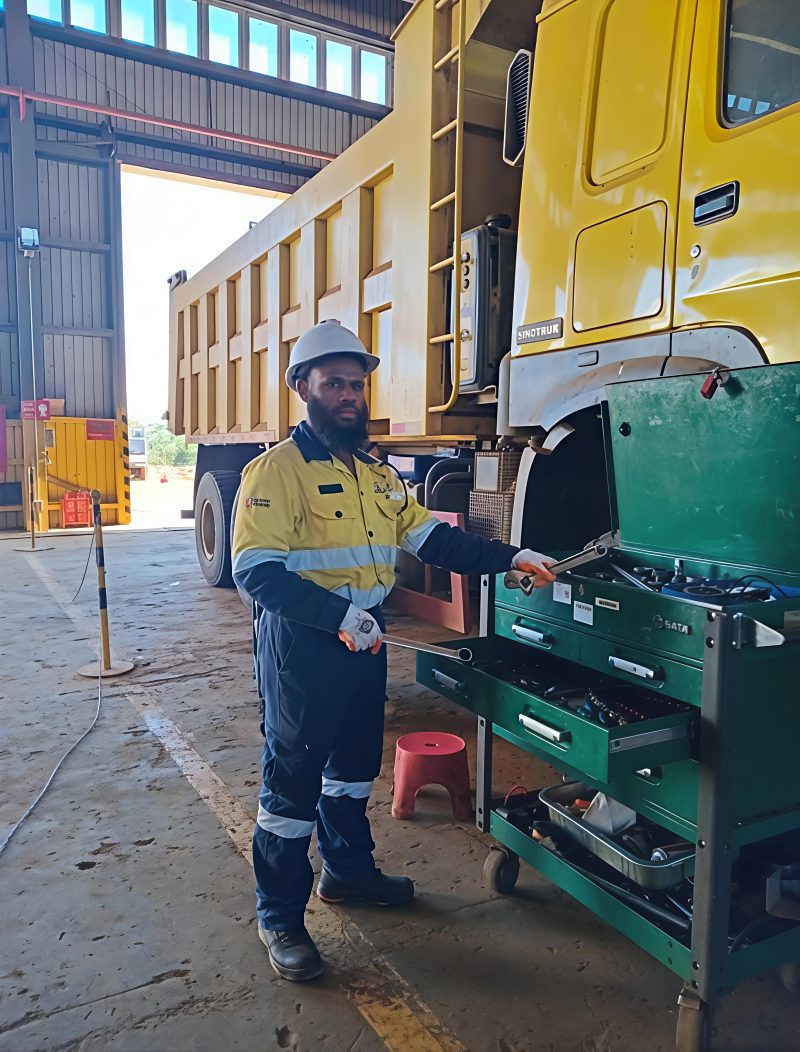
That excitement soon translated into an invaluable learning experience during his seven-month rotation at the KBK Mobile Workshop, one of the mine’s most critical operational departments.
The KBK Mobile Workshop serves as the backbone of the mine’s vehicle maintenance operations. Divided into the Pit 4 Workshop and the Main Workshop, it plays a significant role in ensuring mining activities continue without interruption. With responsibility for maintaining both light and heavy equipment, the department directly influences the efficiency and profitability of mining operations.
Within the workshop are four specialised sections: Planning, Light Vehicle Maintenance, Heavy Vehicle Maintenance, and Tyre Fitting. Together, these teams work tirelessly to minimize equipment downtime and maximise operational productivity.
For Gono, the rotation provided a rare opportunity to witness how technical planning and hands-on maintenance come together to keep one of Papua New Guinea’s largest mining operations running smoothly.
Throughout his placement, James gained knowledge that extended far beyond classroom learning.
He developed a strong understanding of the various components and functions of both heavy and light vehicles, while learning to identify faults through systematic troubleshooting techniques.
One of the highlights of his training was becoming familiar with the FleetMEX maintenance management system, where he learned how planners and schedulers organize daily maintenance activities and monitor vehicle performance.
His responsibilities also included carrying out vehicle inspections and condition monitoring, selecting and using the correct tools for specific maintenance tasks, and participating in routine servicing and repairs.
Gono also became familiar with the workshop’s structured maintenance schedules.
During an A Service, conducted every 5,000 kilometres, mechanics replace engine oil and oil filters. A B Service builds upon the A Service by replacing fuel filters and differential oil, while the more comprehensive C Service includes replacement of air filters, fuel filters, oil filters and other major maintenance requirements to keep equipment operating safely and efficiently.
These practical experiences strengthened his technical confidence while reinforcing the importance of preventive maintenance in modern mining operations.
Looking back, Gono describes the Mobile Workshop as one of the most rewarding learning environments he has experienced.
It provided the perfect balance between office-based planning and field-based mechanical work, allowing him to understand how scheduling, maintenance planning and practical repairs work together to support uninterrupted mining production.
“The Mobile Workshop has been one of the best learning environments I have experienced. I was able to learn both inside the office and in the field, understanding how planners and schedulers operate while also gaining practical experience in vehicle maintenance and repairs,” he reflected.
Gono credits much of his professional growth to the people who guided him throughout the program.
He expressed sincere appreciation to Ramu niCo Human Resources Team, Mr. Jeffers, and the HR officers for providing the opportunity to participate in the Graduate Development Scheme.
He also thanked his supervisors at the KBK Mobile Workshop, especially Mr. Jimmy, along with the workshop team whose mentorship, patience and daily guidance helped him develop both technically and professionally.
James Gono’s story reflects the purpose of Ramu NiCo’s Graduate Development Scheme to bridge the gap between university education and industry by equipping young Papua New Guineans with practical workplace experience.
From a young student in the highlands of Jiwaka to a graduate developing critical maintenance and planning skills in one of the country’s major mining operations, James’ journey demonstrates what dedication, quality education and meaningful industry training can achieve.
As he continues to build his career, Gono represents a new generation of Papua New Guinean professionals ready to contribute to the nation’s growing mining industry through knowledge, commitment and a willingness to keep learning.